Inverter vs Normal Compressor: Easy Guide for Buyers
Published: 1 Oct 2025
Ever wondered why some fridges use less power even though they run all day? The answer lies in the difference between an inverter and a normal compressor. These two types of refrigerator compressors may look similar on the outside, but they work very differently inside. In this post, we’ll clear up the confusion and help you pick the right one.
So are you ready? Let’s move on to our article and learn everything in detail.
What Is a Compressor in a Refrigerator?
A compressor is like the heart of your refrigerator. Just like a heart pumps blood to keep our body working, the compressor pumps a special gas called refrigerant to keep your fridge cool. It helps move this gas through the cooling system. When the inside of your fridge gets warm, the compressor turns on and starts working to cool it down again.
You can think of it like a fan that turns on whenever the fridge needs to chill things. Without the compressor, your food would not stay fresh or cold. It’s a small part, but it does a big job!
What Is a Normal (Fixed-Speed) Compressor?
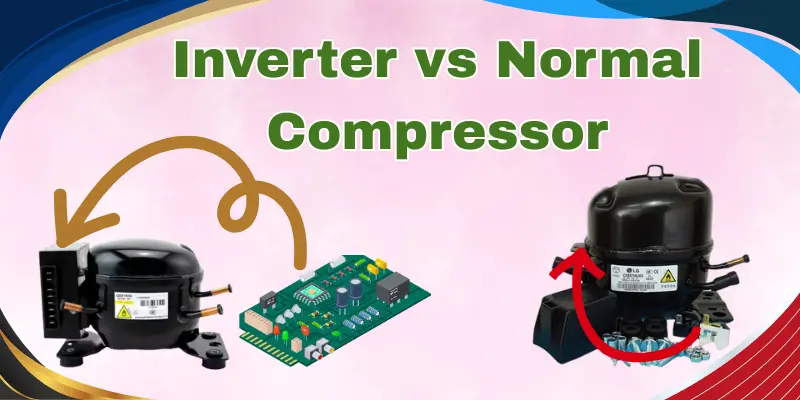
A normal compressor, also called a fixed-speed compressor, works simply. It has only two modes—on or off. When your fridge gets warm, it turns on and runs at full power to cool things down. Once the right temperature is reached, it turns off completely. This stop-and-start process happens many times a day. Because it always runs at full speed, it uses more electricity.

You can think of it like a car that can only go full speed or stop completely—there’s no middle gear. This type of compressor is common in older or budget-friendly refrigerators.
What Is an Inverter Compressor?
An inverter compressor is a smarter and more efficient type of compressor. Instead of just turning on and off like a normal one, it runs at different speeds. When your fridge needs more cooling, it speeds up. When less cooling is needed, it slows down but doesn’t turn off completely. This helps keep the temperature steady and saves more electricity. It also makes the fridge quieter and helps it last longer.

You can think of it like a car that gently speeds up or slows down depending on the road, instead of stopping and starting all the time. This smooth working style makes inverter compressors better for everyday use.
Key Differences: Inverter vs Normal Compressor
Before we go into the details, here’s a quick table to show you how these two types compare:
| Feature | Inverter Compressor | Normal Compressor |
| Working Style | Runs at variable speeds | Runs at full speed or turns off |
| Cooling Control | Smooth and steady cooling | Cooling goes up and down |
| Power Use | Saves more electricity | Uses more electricity due to frequent on/off |
| Noise Level | Quieter operation | Louder because of stop-start noise |
| Temperature Maintenance | Keeps the temperature more stable | Temperature may fluctuate |
| Life Span | Usually lasts longer | May wear out faster due to heavy switching |
| Cost | Higher upfront cost | Cheaper to buy |
| Best For | Daily use, energy saving, long-term use | Small budgets or less frequent fridge use |
| Example | Like a smart car adjusting speed smoothly | Like a car that only goes full speed or stops |
So, guys, now we will discuss each point in the table in detail one by one. So are you ready? Let’s see.
1. Working Style
The biggest difference between the two compressors is how they operate. An inverter compressor runs at variable speeds. This means it can speed up when your fridge needs more cooling and slow down when less cooling is needed. It doesn’t shut off completely but keeps working at a lower speed. On the other hand, a normal compressor works in an on/off way. It runs at full speed to cool the fridge and then turns off once the temperature is reached. It keeps repeating this stop-start cycle all day.
2. Cooling Control
In terms of cooling, an inverter compressor offers smooth and steady cooling. Since it adjusts its speed based on the cooling demand, it maintains a constant temperature inside the fridge. This is especially good for keeping food fresh for longer. A normal compressor, however, cools in cycles. When it turns on, it cools quickly, and when it turns off, the temperature may rise slightly. This leads to ups and downs in cooling, which may affect food freshness.
3. Power Use
When it comes to electricity use, the inverter compressor is more efficient. Because it doesn’t switch off and on often, it avoids wasting power. It adjusts its power use based on how much cooling is needed, which helps save on your electricity bill. In contrast, a normal compressor uses more electricity. Every time it turns back on, it uses a lot of power to restart, and since this happens frequently, the energy consumption is higher over time.
4. Noise Level
The noise level is another big difference. Inverter compressors work quietly. Since they change speed smoothly and don’t turn off suddenly, they don’t make loud sounds. You may barely notice when they’re running. On the other hand, normal compressors can be noisy. You might hear a clicking or humming sound each time they turn on or off, which can be disturbing, especially at night or in quiet places.
5. Temperature Maintenance
Inverter compressors are better at keeping a steady temperature. Since they never turn off completely and run continuously at low or high speeds, they can keep the inside of the fridge cool and constant. This is helpful for items like milk, fruits, and vegetables that need stable conditions. But with a normal compressor, the temperature often changes. It cools fast when it runs and then stops, which may lead to uneven cooling across the fridge.
6. Life Span
An inverter compressor usually lasts longer. Because it runs smoothly and doesn’t stop and start often, it puts less pressure on its parts. This makes the compressor more durable and less likely to break down. That’s why many inverter fridges come with longer warranties. A normal compressor tends to wear out faster. The constant turning on and off can stress the motor and other parts, which may lead to more repairs or early replacement.
7. Cost
Inverter fridges are more expensive to buy upfront. But even though the initial cost is higher, they save you money in the long run through lower electricity bills. It’s a smart investment for homes that use the fridge every day. On the other hand, fridges with normal compressors are cheaper at first. This makes them more budget-friendly if you’re looking to save money when buying. However, they may end up costing more in energy use over time.
8. Best For
An inverter compressor is best for people who use their fridge often, like families or busy households. It’s also a great choice for those who want to save on power and enjoy quiet operation. A normal compressor is suitable for people who use their fridge less, such as single users or small families. It’s also a good option if you need a basic fridge for occasional use and don’t want to spend much initially.
9. Example to Understand
To help you picture the difference, think of an inverter compressor like a smart car that speeds up or slows down smoothly depending on the traffic. It works smarter, uses less fuel, and is easier on the engine. A normal compressor is like a car that only has two modes—full speed or stop. It uses more fuel, makes more noise, and the engine gets tired faster.
Which One Should You Choose?
Let’s make it super easy to understand. You’ve learned the differences. Now it’s time to choose the right one for your home. Don’t worry—we’re here to help!
Choose an Inverter Compressor If:
- You want to save money on electricity bills every month.
- Your fridge runs all day, and you open it many times.
- You want less noise in your kitchen.
- You live in a place where power cuts happen often.
- You are okay with paying a little more at first for long-term savings.
👉 Example: If you have a family, or you cook and store a lot of food, an inverter compressor is a smart pick.
Choose a Normal Compressor If:
- You want a fridge that is cheap to buy right now.
- You don’t use your fridge a lot, or only keep a few items.
- You are buying a second fridge for guests or a small room.
- You are okay if it uses a bit more power and makes more sound.
👉 Example: If you live alone or use the fridge only for water bottles and snacks, a normal compressor will do the job.
Quick Tip from the Expert:
Think about your daily life.
If your fridge is always working, go with an inverter.
If your fridge is used just sometimes, a normal compressor is fine.
It’s not just about price—it’s about how you use the fridge!
Questions About Inverter and Non-Inverter Refrigerator Compressors
Refrigerators are something we use every day, but we often don’t think much about what’s happening inside. After learning the difference between inverters and normal compressors, you might still have a few more questions in mind. That’s totally okay! Let’s look at some common questions that people often ask.
Here’s a list of helpful questions:
- Which compressor type is better for areas with very hot weather?
- Do inverter compressors need more maintenance than normal ones?
- Can I replace a normal compressor with an inverter one in my old fridge?
- What happens if a fridge with an inverter compressor gets damaged by a power surge?
- How do I know which compressor type is inside my refrigerator?
- Are inverter compressors good for deep freezers too?
- Is the food quality better in inverter compressor fridges?
- Can inverter compressors run on solar power or inverters during outages?
- Which compressor type is more eco-friendly or uses less harmful gas?
- Do inverter fridges take longer to cool when first turned on?
Inverter compressors are better for hot weather because they can adjust their speed based on the cooling need. This means they work harder when the temperature rises and slow down when it’s cooler. As a result, the fridge stays steady even during heat waves. They also use less energy, making them both reliable and efficient.
No, inverter compressors usually need less maintenance than normal ones. This is because they run smoothly without the constant stop-and-start cycles of regular compressors. Their steady performance reduces wear and tear on the parts. With proper care, they can last longer and give fewer problems over time.
In most cases, it’s not possible to replace a normal compressor with an inverter type. An inverter compressor requires special controls and electronics that older fridges don’t have. Trying to switch them would mean changing many internal parts, which is costly and impractical. It’s usually better to invest in a new fridge with built-in inverter technology.
A power surge can damage any refrigerator, whether it has a normal or inverter compressor. However, some inverter fridges come with built-in surge protection that helps reduce the risk. Even then, it’s a good idea to use a voltage stabilizer for extra safety. This keeps your fridge protected and helps it last longer.
You can find out by checking the user manual, looking at the label, or sticker on your fridge. If it says “Inverter Technology” or “Digital Inverter,” then your fridge has an inverter compressor. Sometimes brands also advertise this feature on the front of the fridge. If you’re still unsure, you can also ask the manufacturer or dealer.
Yes, inverter compressors are also used in deep freezers. They provide steady cooling that helps keep frozen food at the right temperature. Because they adjust their speed, they use less energy compared to traditional compressors. This makes them both cost-saving and reliable for long-term storage.
Yes, food usually stays fresher in inverter fridges. This is because the cooling remains stable without big temperature swings. Fresh produce, milk, and cooked meals can last longer when the temperature doesn’t go up and down. Inverter cooling also helps reduce ice crystals in frozen food, keeping quality better over time.
Yes, inverter compressors are energy-efficient and use less power, which makes them a good choice for solar systems or home inverters. They can keep working during power cuts without putting too much load on the backup supply. This is especially useful in areas where outages happen often. With solar panels, they can save even more energy and costs.
Both normal and inverter compressors can use eco-friendly refrigerants, depending on the model. However, inverter compressors are more eco-friendly overall because they consume less electricity. Lower energy use means fewer greenhouse gases from power plants. Over time, this makes inverter fridges a better choice for the environment.
Yes, inverter fridges may take a little longer to cool down when first switched on. This is because they start slowly and build up cooling power gradually. Once the set temperature is reached, they keep it steady without big changes. The slower start saves energy and helps the compressor last longer.
Conclusion
So, guys, in this article, we’ve covered the Difference Between an Inverter & Normal Compressor in detail.
Based on everything we’ve learned, I personally recommend the inverter compressor for most homes. It gives better performance, saves power, and keeps food fresher for longer. Of course, if you just need something basic, a normal compressor can still work.
👉 If you found this helpful, share it with others or leave a comment below with your fridge questions!