How to Save Electricity with AC Using These Smart Tricks
Published: 2 Nov 2025
Have you ever looked at your electricity bill and wondered why it’s so high even though you only use your air conditioner for a few hours? You’re not alone. Many people love the comfort of a cool room, but get worried when the bill arrives at the end of the month. It often feels confusing. Can something so small make such a big difference in cost?
Don’t worry. The good news is, saving electricity while using your AC isn’t hard at all. You just need to know a few simple tricks that really work. In this guide, we’ll walk you through how to save electricity with AC in clear, easy steps. You’ll learn smart ways to stay cool, use less power, and still enjoy your comfort without feeling guilty about the bills.
So, are you ready? Let’s start.
What You Need Before You Start
Before you begin learning how to save electricity with your AC, it’s good to get a few things ready. These will help you check your air conditioner properly and follow the steps easily. Don’t worry, nothing fancy is needed, just some simple tools and a bit of awareness.
- User Manual of Your AC
This little book helps you understand your AC’s buttons and modes. Knowing what each setting does will make it easier to use your AC smartly. - A Clean Cloth or Small Brush
You’ll need this to wipe or clean the air filters. Clean filters help your AC cool faster and use less power. - A Thermometer or Temperature App
Helps you keep track of the room temperature. This way, you’ll know if your AC is working efficiently. - A Basic Understanding of Your Power Bill
Knowing how your electricity bill works will help you see the changes once you start saving energy. - Patience and Consistency
Saving electricity doesn’t happen overnight. Stay calm, follow the tips, and you’ll start seeing results soon.
Step-by-Step Guide: How to Save Electricity with AC
Before we start, remember this. Saving electricity does not mean you have to stop using your AC. It is all about using it smartly. Follow these steps one by one, and you will soon notice your bills getting lighter while your room stays just as cool.
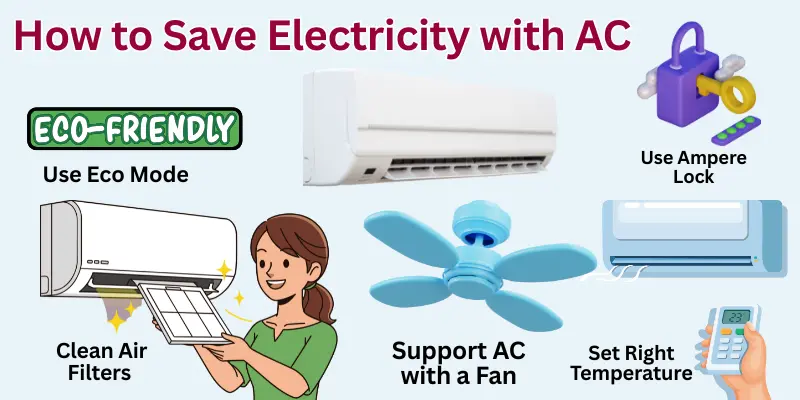
Here are the steps you will learn:
- Step 1: Set the Right Temperature
- Step 2: Use Energy-Saver or Eco Mode
- Step 3: Clean the Air Filters Regularly
- Step 4: Keep the Room Closed and Covered
- Step 5: Give Your AC Regular Maintenance
- Step 6: Use a Smart Timer or Thermostat
- Step 7: Support Your AC with a Ceiling Fan
- Step 8: Check the Outdoor Unit
- Step 9: Upgrade to an Inverter AC (If You Can)
- Step 10: Be Consistent with Good Habits
- Step 11: Use the Ampere Lock Option in Inverter ACs
Now we will discuss all the points one by one.
Step 1: Set the Right Temperature
Let us begin with the most important part, the temperature.
Set your AC between 24°C and 26°C. This range keeps your room cool without forcing the AC to work too hard.
Here is a quick example.
If you set it at 18°C, your AC will keep running longer to reach that low temperature. That means more power is used. But at 25°C, it cools just enough and saves energy.
So next time, check your remote and keep it around 24°C. You will still feel fresh and comfortable.
Step 2: Use Energy-Saver or Eco Mode
Most modern ACs have a mode called Energy Saver, Eco Mode, or Sleep Mode.
Turn it on whenever you can. This mode switches the compressor on and off automatically, keeping the temperature steady and saving electricity at the same time.
If your AC does not have this mode, try using the Fan Mode after the room cools down. It circulates the cool air without using much power.
Step 3: Clean the Air Filters Regularly
Dusty filters make your AC work harder, which means more power use.
Take out the filters once every two to three weeks and clean them gently with water or a small brush. Let them dry completely before putting them back.
Clean filters allow smooth airflow, faster cooling, and lower electricity use, all in one simple step.
Step 4: Keep the Room Closed and Covered
Always shut doors and windows when your AC is on.
If warm air enters the room, your AC will work extra hard to keep things cool.
You can also use curtains or blinds to block sunlight during the day. It keeps the room naturally cooler, so your AC does not have to overwork.
Step 5: Give Your AC Regular Maintenance
Even a small problem like a gas leak or dirty coil can make your AC use more power.
Call a professional technician for servicing at least once every year, preferably before summer.
Regular maintenance keeps your AC running smoothly and helps you get the best cooling with the least electricity use.
Step 6: Use a Smart Timer or Thermostat
Do not keep your AC running when it is not needed.
Use the timer feature to turn it off automatically after a few hours, or install a smart thermostat that adjusts temperature based on the room’s condition.
This helps you avoid waste and keeps your comfort level perfect all night long.
Step 7: Support Your AC with a Ceiling Fan
After your room gets cool, turn on a ceiling fan to spread the air evenly.
This helps you feel cooler even if you raise the AC temperature by a degree or two.
A simple fan can reduce AC use time and help save a lot of electricity.
Step 8: Check the Outdoor Unit
Your outdoor unit also needs attention.
Keep it clean and make sure there is no dust, leaves, or objects blocking airflow.
If possible, place it in a shaded area. When the outdoor unit stays cooler, it works more efficiently.
Step 9: Upgrade to an Inverter AC (If You Can)
If your AC is old, it might use more power than new models.
Modern inverter ACs adjust their compressor speed to maintain cooling, so they use less energy.
It may be a bigger investment, but it can save you a lot of money in the long run.
Step 10: Be Consistent with Good Habits
Finally, make saving electricity a daily habit.
Set the right temperature, clean filters regularly, and turn off the AC when you leave the room. Small actions done regularly bring big savings.
Remember, your AC is your friend. Treat it well, and it will take care of you while keeping your bills low.
Step 11: Use the Ampere Lock Option in Inverter ACs
Some inverter ACs come with an ampere lock feature with levels like L1, L2, and L3.
These levels control how much electricity your AC can use.
For example, setting it to L1, L2, or L3 limits power use and keeps your AC from drawing more current than needed.
This way, you still get good cooling but save electricity at the same time.
It is a smart feature, especially when you want comfort and control over your power bill.
Extra Tips and Best Practices
Here are some extra ideas to help you save more electricity when using your AC. These are easy to follow and make a big difference over time.
- Use your AC only when needed.
Turn it on when the room feels hot, not all day. - Turn off lights and gadgets.
They make the room warm and force the AC to work harder. - Keep doors closed tightly.
Stop cool air from escaping. - Use light-colored curtains.
They block sunlight and keep your room cooler. - Switch to LED bulbs.
They produce less heat and save electricity, too. - Use ceiling fans with your AC.
Fans help spread cool air faster. - Avoid opening the fridge often.
It releases warm air and makes your room warmer. - Do not place heat sources near the AC.
Items like lamps or ovens confuse the thermostat. - Keep furniture away from air vents.
It allows free airflow around the room. - Use your AC timer.
Set it to turn off after you sleep or leave the house. - Check AC wiring once a year.
Faulty wiring wastes electricity and can damage the unit. - Upgrade your home insulation.
Thick curtains or weather strips help keep cool air inside. - Wear light clothes at home.
You will feel cooler and may not need very low temperatures. - Keep plants near windows.
They block heat and make your home fresher. - Do not forget yearly servicing.
A clean and well-maintained AC always uses less power.
Common Problems and Fixes
Here are some common mistakes people make when trying to save electricity with their AC. Do not worry if you do any of these. The fixes are easy and work well once you start using them.
- Problem: Setting the AC temperature too low.
Fix: Keep it between 24°C and 26°C. It cools well and saves power. - Problem: Forgetting to clean the air filters.
Fix: Wash or brush the filters every two to three weeks to help the AC breathe better. - Problem: Leaving doors or windows open.
Fix: Close all doors and windows tightly before turning on the AC. - Problem: Ignoring regular servicing.
Fix: Get your AC serviced once a year to keep it clean and working smoothly. - Problem: Placing heat-producing items near the AC.
Fix: Keep lamps, ovens, and other heat sources away from the indoor unit. - Problem: Using the wrong AC mode.
Fix: Choose Eco or Energy Saver Mode for daily use. It gives comfort and saves energy. - Problem: Not using the fan or timer features.
Fix: Use the ceiling fan with your AC and set the timer to turn it off when not needed. - Problem: Blocking the air vents with furniture.
Fix: Leave some space around the vents so cool air can flow freely. - Problem: Ignoring the outdoor unit.
Fix: Clean the outdoor unit and keep it in a shaded area for better performance. - Problem: Running the AC all night.
Fix: Use the sleep or timer mode so it turns off after a few hours. - Problem: Not using the ampere lock-in inverter ACs.
Fix: Set it to L1, L2, or L3 to control how much power the AC uses. - Problem: Expecting results too fast.
Fix: Be patient and consistent. Energy savings show up slowly but surely.
Conclusion
Now you know how to save electricity with AC in easy and smart ways. By setting the right temperature, cleaning filters, using Eco Mode, and keeping your room closed, you can enjoy cool air without high bills.
Every small step you take makes a big difference. Your AC will run better, last longer, and save you more money each month.
Keep practicing these habits every day. Try using a timer, ceiling fan, or ampere lock to see even more savings.
You are now ready to enjoy comfort and save energy at the same time. Stay cool, save smart, and keep learning new ways to use your AC wisely!
Question and Answer
Here are some extra questions people often ask about saving electricity with air conditioners. These answers will help you understand more about how to keep your AC smart and efficient.
Yes, it can help a little. When you set the fan speed high, the cool air spreads faster and cools the room evenly. This means your AC does not need to run the compressor for too long. Once the room is cool, you can lower the fan speed to maintain comfort. It is a simple trick to reduce power use without losing coolness.
The right size depends on your room area. A small AC in a large room works too hard, and a big one in a small room wastes energy. For a small bedroom, a 1-ton AC is often enough. For medium rooms, 1.5 tons is better, and for larger spaces, 2 tons or more may be needed. Choosing the correct size keeps cooling smooth and power bills low.
Yes, in humid weather it can. The “Dry” mode removes moisture from the air and keeps the room comfortable without dropping the temperature too much. It uses less power because the compressor runs for shorter times. It is perfect for rainy or coastal areas where humidity is high. Try it on muggy days to feel fresh and save some power.
If you are going out for more than an hour, turn it off. Keeping it on wastes electricity since it keeps cooling an empty room. When you return, the room may feel warm, but the AC will cool it again in a few minutes. You can also use the timer to switch it on before you get back. This way, you save power and still return to a cool space.
It makes a big difference. Good insulation keeps cool air inside and blocks heat from coming in. Thick curtains, sealed windows, and insulated walls all help the AC work less. When the cool air stays longer, the compressor doesn’t have to run often. This small change can reduce your AC’s power use by a noticeable amount.
Yes, sunlight adds a lot of heat to your room, especially in the afternoon. If you block it with curtains or blinds, the room stays cooler naturally. Your AC then needs to run for a shorter time to reach the set temperature. Light-colored curtains work best as they reflect heat. This is an easy and low-cost way to save electricity.
It’s a good idea if you want to understand how much power your AC uses. A smart power meter shows real-time data about electricity use. You can check which settings or modes use more energy and adjust them. It helps you plan your AC use better and cut waste. Over time, this habit can bring big savings.
Standby power is the small amount of electricity used when the AC is off but still plugged in. It powers the remote sensor and display light. You can stop this by unplugging the AC or turning off the switch when not in use. It might seem small, but over months, it adds up. Cutting standby power is one more way to lower your bill.
Yes, it can improve efficiency a lot. Curtains and blinds keep out sunlight and reduce heat buildup. The AC then cools the room faster and runs less often. Dark or heavy curtains are good for very sunny rooms. This small step makes your home more comfortable and helps the AC save power.
If your AC runs all the time but the room never feels cool, it might be too small. If it cools too quickly and shuts off often, it may be too big. Both cases waste electricity. The right AC should cool the room smoothly and maintain the temperature without too many stops or long runs. Checking the tonnage against your room size is the best way to fix this.