How Much Power a Small Refrigerator Uses and Easy Ways to Save
Published: 17 Nov 2025
Do you ever wonder how much power does a small refrigerator use? Knowing this can help you understand your electricity bills, save energy, and even plan for solar or backup power. Many people also search for how much energy a mini fridge uses, because these small fridges are common in dorm rooms, offices, and bedrooms.
In this article, we will discuss the actual power and energy usage, why it changes, how to measure it, ways to save electricity, and real-life examples.
Are you ready? Let’s get started!
Quick Answer (TL;DR)
A small refrigerator usually uses 100–250 watts of power, depending on its size and settings. A mini fridge typically consumes 0.6–1.2 kWh of energy per day.
This gives you a quick idea, but we’ll break down all the details and show you why these numbers can change and how to measure them.
What Is a Small / Mini Refrigerator?
A small refrigerator, also called a mini fridge, is a small fridge that keeps your food and drinks cold. It is smaller than a normal fridge you see in most kitchens. People use them in dorm rooms, offices, bedrooms, or even small apartments.

Small fridges usually have a size of 1 to 4 cubic feet. Some are very tiny and fit on a desk, and some are a bit bigger and can hold more food.
Mini refrigerators work like normal fridges. They keep food cool using a compressor, and some have a small freezer inside. Because they are small, they use less electricity than full-size fridges.
Power Use Basics
Small fridges and mini fridges do not all use the same amount of electricity. The power they use depends on size, type, and how you use them. Let’s look at the main numbers.
1. How Much Power Does a Small Refrigerator Use?
A small refrigerator usually uses 100 to 250 watts when it is running. This means the fridge needs this much power from your electricity to keep your food cold. Bigger mini fridges are closer to 200–250 watts, while tiny ones can be around 100 watts.
2. Starting / Surge Watts
When a fridge first turns on, it may need extra power for a few seconds. This is referred to as starting or surge watts. For small fridges, this can be 200 to 400 watts, even if the normal running power is much lower.
3. How Much Energy Does a Mini Fridge Use (Daily kWh)
Energy is measured in kWh (kilowatt-hours). A mini fridge usually uses about 0.6 to 1.2 kWh per day.
Example:
- Tiny fridge (100 W) runs about 8 hours → 0.1 × 8 = 0.8 kWh/day
- Bigger fridge (200 W) runs about 10 hours → 0.2 × 10 = 2 kWh/day
4. Monthly & Yearly Consumption
You can calculate monthly and yearly energy easily:
Example:
- Small fridge: 0.8 kWh/day × 30 days = 24 kWh/month
- Mini fridge: 1.2 kWh/day × 30 days = 36 kWh/month
In a year, that is about 288–432 kWh, depending on size and usage.
Why Power / Energy Use Changes
Small fridges and mini fridges do not always use the same amount of power. Many things can make them use more or less electricity. Understanding these reasons helps you save energy and know why your fridge bill changes.
Here are the main reasons power and energy use can change:
- Compressor On–Off Cycle
- Temperature Setting
- Room Temperature
- Door Opening Habits
- Age & Insulation
- Airflow & Placement
- Manual vs Auto-Defrost
- Energy Rating
Now, let’s explain each one in simple words with examples.
1. Compressor On–Off Cycle
The compressor is the main part that cools the fridge. It does not run all the time and turns on or off depending on the temperature.
- The compressor runs only when cooling is needed.
- Turns off when the fridge reaches the set temperature.
- Small fridges cycle more often in hot rooms.
- New fridges usually have efficient cycles.
- Older fridges may run longer to stay cold.
Example: A mini fridge in a warm dorm room may run 8 hours a day, while the same fridge in a cool bedroom may run only 5 hours.
2. Temperature Setting
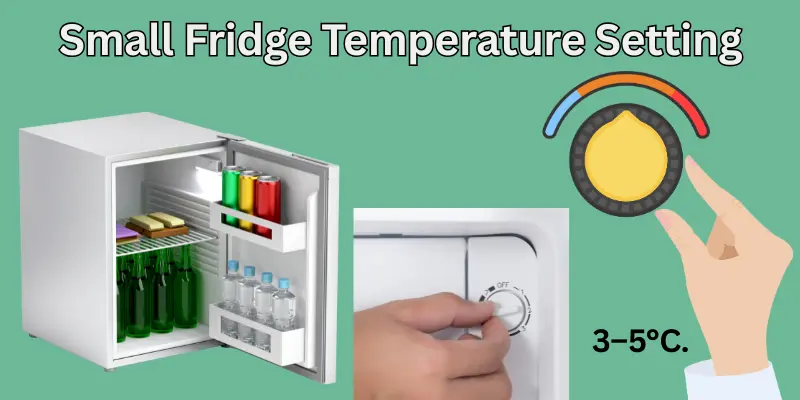
The temperature you set on your fridge affects how much power it uses. The colder you set it, the more electricity it needs to stay cool.
- Lower temperature = more power used.
- Higher temperature = less electricity used.
- Fridges set too cold for no reason waste energy.
- Small fridges usually have simple dial or digital settings.
- The optimal fridge temperature is usually 3–5°C.
Example: A mini fridge set at 2°C uses more electricity than the same fridge set at 5°C, even if the fridge is the same size.
3. Room Temperature
The temperature of the room where the fridge is placed affects how much electricity it uses. The hotter the room, the harder the fridge works to stay cold.
- Hotter rooms make the fridge run longer.
- Cooler rooms reduce power use.
- Direct sunlight increases energy consumption.
- Small, enclosed spaces trap heat and increase power use.
- Air-conditioned rooms help the fridge use less electricity.
Example: A mini fridge placed near a sunny window in summer may run almost all day, while the same fridge in a cool office uses much less power.
4. Door Opening Habits
Every time you open the fridge, cold air escapes, and the fridge needs more power to cool again. How often and how long you open the door affects energy use.
- Frequent opening makes the fridge work harder.
- Leaving the door open for long increases electricity use.
- Small fridges lose cold air faster than large fridges.
- Opening the fridge for snacks many times a day uses more energy.
- Closing the door quickly saves power.
Example: A mini fridge opened 20 times a day uses more electricity than the same fridge opened only 5 times.
5. Age & Insulation
The age of a fridge and how well it is insulated affect its power use. Older fridges or fridges with thin walls need more electricity to stay cold.
- Older fridges run longer than new fridges.
- Poor insulation makes the fridge work harder.
- Newer fridges are usually more energy-efficient.
- Well-insulated mini fridges keep cold air longer.
- Fridges with damaged seals lose cold air and use more power.
Example: A 10-year-old mini fridge in an office may use more electricity than a new mini fridge of the same size and type.
6. Airflow & Placement
Where you place your fridge affects how much electricity it uses. Fridges need space around them for air to move freely.
- A fridge pushed into a corner uses more power.
- Keeping walls or objects too close blocks airflow.
- Small fridges need space behind and on the sides.
- Air circulation helps the compressor run less.
- Placing the fridge away from heat sources saves energy.
Example: A mini fridge placed against a wall without space around it will use more electricity than one with 5–10 cm space on all sides.
7. Manual vs Auto-Defrost
Fridges can either defrost manually or automatically. How they handle frost affects how much power they use.
- Auto-defrost fridges use extra electricity to melt ice regularly.
- Manual defrost fridges use slightly less power.
- Auto-defrost keeps fridge walls free of ice but consumes more energy.
- Manual defrost requires you to remove ice yourself, saving electricity.
- Mini fridges may have small freezers that frost faster.
Example: A mini fridge with auto-defrost in a hot office may use more energy each month than a manual defrost fridge of the same size.
8. Energy Rating
The energy rating of a fridge shows how efficiently it uses electricity. Higher ratings mean the fridge uses less power for the same cooling.
- Energy-efficient fridges use less electricity.
- Look for labels like Energy Star or local rating systems.
- Fridges with low ratings use more power even if they are small.
- Choosing a good-rated fridge saves money and energy.
- Mini fridges with high ratings are better for long-term use.
Example: An Energy Star mini fridge can save 10–20% electricity compared to a standard mini fridge of the same size.
How to Measure the Power Use of Your Fridge
Measuring the electricity your fridge uses is easier than many people think. There are a few simple ways you can do it at home.
1. Check the Fridge Label
Most fridges have a label or nameplate, usually inside or on the back. This label often shows the power in watts or sometimes the expected energy use per day or year. Checking this gives you a quick estimate of how much electricity the fridge might use without needing any tools.
2. Use a Plug-In Power Meter
A plug-in power meter is a small device you connect between your fridge and the wall socket. It measures the electricity used while the fridge is running. Some meters also show the extra power used when the compressor starts. You can leave it plugged in for a few days to get an average reading.
3. Smart Plug With Energy Tracking
Smart plugs with energy tracking are another easy option. You connect the fridge to the smart plug, and it links to an app on your phone. The app can show real-time electricity use, daily or monthly energy use, and even let you track patterns to save power.
4. Simple DIY Formula (Watts to kWh)
If you prefer, you can calculate energy use yourself. Take the fridge’s running watts and multiply by the hours it runs per day. Then divide by 1000 to convert to kilowatt-hours (kWh). This gives a simple estimate of daily energy use.
Example: A mini fridge rated 100 W runs for 8 hours a day. Using the formula: 100 × 8 ÷ 1000 = 0.8 kWh per day. This shows both the power it uses in watts and the energy it consumes in kWh.
Cost Calculation
Knowing how much electricity your fridge uses is useful, but it is also important to understand how much it costs. Costs depend on your daily usage, how many days per month you use it, and your local electricity rate.
1. Daily Cost
To calculate the daily cost, multiply the energy used in kWh by your electricity rate per kWh.
Examples of electricity rates:
- Low: $0.10 per kWh
- Medium: $0.15 per kWh
- High: $0.20 per kWh
Example: A mini fridge uses 0.8 kWh per day.
- Low rate: 0.8 × 0.10 = $0.08/day
- Medium rate: 0.8 × 0.15 = $0.12/day
- High rate: 0.8 × 0.20 = $0.16/day
2. Monthly Cost
For the monthly cost, multiply the daily cost by 30 days.
Example: Using the same mini fridge:
- Low rate: $0.08 × 30 = $2.40/month
- Medium rate: $0.12 × 30 = $3.60/month
- High rate: $0.16 × 30 = $4.80/month
3. Yearly Cost
For yearly cost, multiply the daily cost by 365 days.
Example:
- Low rate: $0.08 × 365 = $29.20/year
- Medium rate: $0.12 × 365 = $43.80/year
- High rate: $0.16 × 365 = $58.40/year
Comparison Table:
| Electricity Rate | Daily Cost | Monthly Cost | Yearly Cost |
| Low ($0.10/kWh) | $0.08 | $2.40 | $29.20 |
| Medium ($0.15/kWh) | $0.12 | $3.60 | $43.80 |
| High ($0.20/kWh) | $0.16 | $4.80 | $58.40 |
Power Use for Solar, Inverters & Backup Systems
If you want to run a small fridge or mini fridge on solar panels, inverters, or a backup battery, you need to know how much power it uses. This helps you choose the right inverter, battery, and setup to keep the fridge running safely.
1. Running Watts Needed
Running watts are the amount of power the fridge uses while it is running normally.
- Small fridges usually need 100–250 watts when running.
- This number is important to size your inverter and solar system.
- Check the fridge label or use a power meter for exact numbers.
2. Surge Watts Needed
When the fridge starts, the compressor may need extra power, called surge or starting watts.
- Small fridges can need 200–400 watts for a few seconds.
- The inverter should handle this short surge without tripping.
- Knowing surge watts prevents system overload.
3. Minimum Inverter Size
The inverter converts DC (from batteries or solar) to AC (used by the fridge). You must size it correctly.
- Minimum inverter watts = running watts + a small margin.
- Include surge watts in consideration.
- Example: If the fridge runs at 120 W and the surge is 250 W, an inverter ≥ 300 W is safe.
4. Battery Size Needed
Battery size determines how long the fridge can run during power outages.
- Calculate daily energy: running watts × hours of use ÷ 1000 = kWh per day.
- Multiply by the days of backup needed.
- Example: Mini fridge 0.8 kWh/day × 1 day = 0.8 kWh battery minimum.
5. Real-Life Example Setup for a Mini Fridge / Small Fridge
Here’s a simple setup example for a mini fridge:
- Running watts: 120 W
- Surge watts: 250 W
- Daily energy: 0.96 kWh (120 W × 8 hours ÷ 1000)
- Minimum inverter: 300 W
- Battery: 1 kWh for 1-day backup
This setup ensures your fridge can run safely on solar or during a power outage without overloading the system.
Mini Fridge vs Full-Size Fridge (Energy Comparison)
Many people wonder how much electricity a mini fridge uses compared to a full-size fridge. Understanding this helps you choose the right fridge for your needs and save energy.
1. Running Watts
Running watts show the power a fridge uses while it is running.
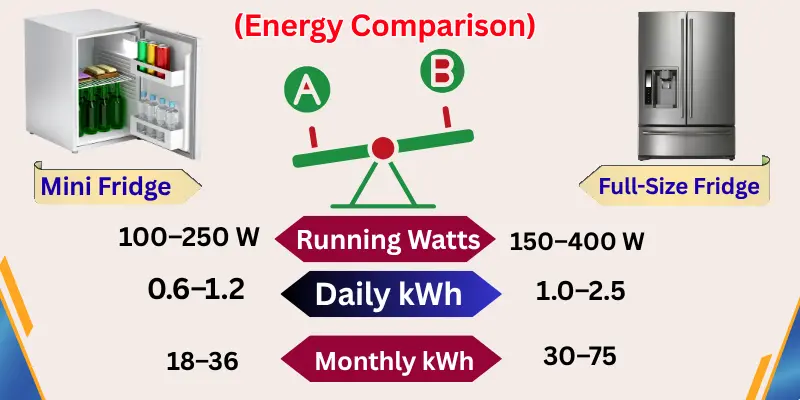
- Mini fridges usually need 100–250 watts.
- Full-size fridges usually need 150–400 watts.
- Bigger fridges use more electricity because they have larger compressors and more space to cool.
2. Daily kWh
Daily energy use is measured in kilowatt-hours (kWh).
- Mini fridge: 0.6–1.2 kWh/day
- Full-size fridge: 1.0–2.5 kWh/day
- Bigger fridges use more energy, even if both are energy-efficient.
3. Monthly kWh
Monthly energy is calculated by multiplying daily kWh by 30 days.
- Mini fridge: 18–36 kWh/month
- Full-size fridge: 30–75 kWh/month
4. Which One Uses Less Power?
Here is a simple comparison to see which fridge uses less electricity:
| Fridge Type | Running Watts | Daily kWh | Monthly kWh |
| Mini Fridge | 100–250 W | 0.6–1.2 | 18–36 |
| Full-Size Fridge | 150–400 W | 1.0–2.5 | 30–75 |
Mini fridges are smaller and use less power, making them ideal for dorms, offices, or small apartments. Full-size fridges are better for families but use more electricity.
If you want to know how many watts a normal refrigerator uses, you can read how many watts of power does a refrigerator uses.
Practical Tips to Reduce Power Use
Small fridges and mini fridges can save a lot of electricity if used properly. Following simple steps can reduce energy bills and keep your fridge running efficiently. Each tip below explains what to do and why it matters.
1. Keep the Door Closed
Every time you open the fridge, cold air escapes, and the fridge has to work harder to cool again. This increases electricity use and can shorten the fridge’s life. Keeping the door closed most of the time is one of the easiest ways to save power.
- Open the fridge only when necessary.
- Close the door quickly after taking items.
- Plan to get everything in one visit.
2. Set the Right Temperature
Setting the fridge at the correct temperature saves electricity and keeps food fresh longer. A fridge that is too cold wastes energy, while a fridge that is too warm may spoil food. Checking and adjusting the temperature regularly helps maintain efficiency.
- Fridge: 3–5°C, Freezer: -18°C.
- Avoid setting the fridge colder than needed.
- Use a thermometer to monitor and adjust the temperature.
3. Clean the Coils
Dust and dirt on the fridge coils make it harder for the fridge to cool efficiently. This forces the compressor to run longer, using more electricity. Cleaning the coils regularly keeps your fridge running smoothly and saves energy.
- Vacuum or wipe coils every 6–12 months.
- Always unplug the fridge before cleaning.
- Keep the area around the coils free from dust.
4. Leave Airflow Space
Fridges need space around them so air can circulate and cool the compressor properly. Blocking airflow makes the fridge work harder, increasing electricity use. Ensuring enough space around the fridge keeps it efficient and extends its life.
- Keep at least 5–10 cm of space around the fridge.
- Do not push the fridge tightly against walls or furniture.
- Ensure vents are not blocked by objects.
5. Keep Away From Heat
Heat from sunlight, ovens, or heaters makes the fridge work harder to maintain cold temperatures. The more the fridge works, the more electricity it consumes. Placing the fridge in a cooler location helps it run efficiently and reduces power use.
- Keep the fridge away from direct sunlight and ovens.
- Avoid placing it near heaters or radiators.
- Place it in a cooler, shaded area of the room.
6. Do Not Overfill
Overloading the fridge blocks airflow inside, preventing proper cooling. When cold air cannot circulate, the fridge uses more electricity to maintain the set temperature. Leaving some space between items allows better cooling and energy efficiency.
- Leave space between items for air to circulate.
- Do not stack food too tightly.
- Avoid storing too many drinks or containers at once.
7. Defrost on Time
Ice build-up reduces cooling efficiency and increases electricity use. Manual defrost fridges need regular attention to prevent thick layers of ice. Removing ice on time helps the fridge run efficiently and keeps energy costs lower.
- Check the freezer once a month for ice.
- Remove ice if it is more than 0.5 cm thick.
- Regular defrosting keeps the fridge running efficiently.
8. Choose an Energy-Efficient Model
Energy-efficient fridges use less power and save money over time. Choosing a fridge with a good energy rating ensures you get the same cooling with less electricity. Newer models are often more efficient than older ones.
- Look for Energy Star or local energy labels.
- Compare energy ratings before buying.
- Newer models usually use less electricity than older ones.
You can also check the advantages and disadvantages of a mini refrigerator to know if it is right for your home.
Real-Life Case Study
Seeing real-life examples helps understand how small changes can save electricity. This case study shows how a student used a mini fridge and what improvements made a difference in power use.
1. Before Improvements
Before making any changes, the fridge was using more electricity than needed due to common habits and placement issues.
- The fridge was placed near a sunny window.
- The door was opened many times a day.
- The temperature was set lower than needed.
Example: A student using a 3.2 cu ft mini fridge noticed high daily electricity use, around 1.2 kWh/day.
2. After Improvements
After following simple tips, the fridge became much more efficient, reducing electricity use significantly.
- Moved the fridge away from direct sunlight.
- Set the temperature to 4°C for the fridge and -18°C for the freezer.
- Minimized door opening and kept airflow space around the fridge.
3. Power / Energy Saved
The changes resulted in noticeable energy savings over time.
- Daily electricity use dropped from 1.2 kWh to 0.8 kWh.
- Monthly energy use reduced from 36 kWh to 24 kWh.
- The student saved money and reduced environmental impact.
Example: After improvements, the student’s 3.2 cu ft mini fridge now costs around $3–4 less per month, depending on electricity rates.
Myths & Mistakes People Make
Many people have wrong ideas about mini fridges and small refrigerators. These myths can make them waste electricity or not use their fridge efficiently. Let’s clear up the most common mistakes.
1. “Mini fridges always use very little energy.”
Many assume that a mini fridge uses almost no electricity, but usage depends on several factors.
- Running hours, room temperature, and fridge size all affect energy use.
- A small fridge in a hot room can use more electricity than expected.
- Power-hungry features like freezers increase energy consumption.
2. “100 watts means 100 watts all day.”
The wattage on the fridge label is the running power, not what it uses continuously.
- The compressor cycles on and off, so average use is lower.
- Daily energy depends on hours of operation, not just watts.
- Using a power meter gives the real daily electricity consumption.
3. “Energy Star = no electricity worries.”
Energy Star or other ratings show efficiency, but they don’t mean the fridge uses no electricity.
- A rated fridge still consumes power depending on usage and settings.
- Poor placement or habits can increase electricity use.
- Always follow proper tips to reduce power, even with energy-efficient fridges.
4. “Coils don’t need cleaning.”
Some people think cleaning the fridge coils is unnecessary, but dirty coils make the fridge work harder.
- Dust and dirt increase electricity use.
- Cleaning once or twice a year keeps the fridge efficient.
- Unplug before cleaning for safety.
Extra Important Questions People Ask
Some people want to know more about power, solar, and batteries when they use a small fridge or mini fridge. These questions help them understand how much power they need and how they can run the fridge in different ways. Here are the simple answers.
Yes, a 2000-watt inverter can run a mini fridge. Most mini fridges only need around 100 to 250 running watts. They also need a short surge when they start, but a 2000-watt inverter can handle that easily. This means the fridge will run smoothly. You will still need a good battery to support the inverter.
One unit is the same as one kilowatt hour. This means 1 unit equals 1000 watts used for one hour. If your fridge uses 100 watts, it must run for ten hours to use 1 unit. This helps you understand your electricity bill. It also helps when you check daily and monthly power use.
A 200W solar panel can run a small fridge only for a short time. Most fridges need steady power all day, and a solar panel cannot work at night. You also need a battery to store extra power. With a battery and a good setup, a 200W panel can help, but may not be enough alone. It works best for very small fridges.
Yes, a 12-volt battery can run a small fridge. You still need an inverter to change the battery power into usable power. The fridge will run for a few hours, depending on the battery size. A bigger battery will run the fridge longer. Many people use this setup for camping or backup power.
Your bill can be high even with solar panels for many reasons. Your home may use more energy than the panels can make. Cloudy days or shade can also lower solar power. Sometimes the system is not big enough for the whole house. Your fridge and other appliances may still draw more power from the grid.
Conclusion
So, guys, in this article, we’ve covered how much power does a small refrigerator use in detail. You now know the running watts, daily energy, reasons why power changes, and simple ways to save electricity. My personal recommendation is to pick an energy-efficient model, keep the fridge in a cool place, and check the temperature settings often so you can cut your electricity bill without any extra effort. If you found this helpful, feel free to leave a comment below and explore more guides on our website.