How Many Watts of Power Does a Refrigerator Use?
Published: 13 Nov 2025
Last month, Sarah noticed her electricity bill was much higher than usual. She realized her old fridge was running constantly, and she had no idea how many watts of power does a refrigerator use. Many of us don’t think about it, but fridges work all day and night, quietly adding to our bills.
Knowing this can help you save energy, reduce costs, and even choose the right fridge for your home. In this article, we will show you typical wattage ranges, real-life examples, and simple tips to measure and lower your fridge’s power use.
So, are you ready? Let’s explore all the details without wasting any time.
Quick Answer – Average Refrigerator Power Use
Most home refrigerators use between 100 and 800 watts of power, depending on their size, model, and age. Knowing how much electricity a refrigerator uses can help you save energy and reduce your bills. Smaller fridges use less power, while older or larger models use more.
Here’s a quick look at average fridge power use:
| Fridge Type | Average Power (Watts) | Daily Energy Use (kWh/day) |
| Mini fridge | 50–150 W | 0.6–1.2 |
| Standard single door | 150–300 W | 1.2–1.8 |
| Double door / full size | 300–800 W | 1.8–3.5 |
| Old models | 500–800 W | 3–4 |
This table shows the typical electricity use of different fridges. Knowing these numbers helps you estimate your energy use and plan for lower bills.
Why Refrigerator Wattage Varies
Not all refrigerators use the same amount of power. The wattage can change depending on several factors:
- Size of the fridge – Mini fridges use less power, while large or double-door models use more.
- Age and technology – Older fridges usually consume more electricity. Modern inverter models are more energy-efficient.
- Compressor type and running cycle – The compressor turns on and off to maintain the temperature, so the fridge doesn’t use full power all the time.
- Temperature settings and door openings – Lower temperatures or frequent door openings make the fridge work harder, using more energy.
Tip: A fridge doesn’t run all the time – its compressor turns on and off. That’s why the actual power use is often lower than the listed wattage.
By understanding these points, you can better estimate how much power a refrigerator uses in a day.
How to Calculate Refrigerator Power Use
Do you ever wonder how much electricity your fridge really uses? It’s actually very simple to find out. By knowing this, you can plan your energy use, save money, and understand your bills better. Let’s go step by step and see how you can calculate it easily at home.
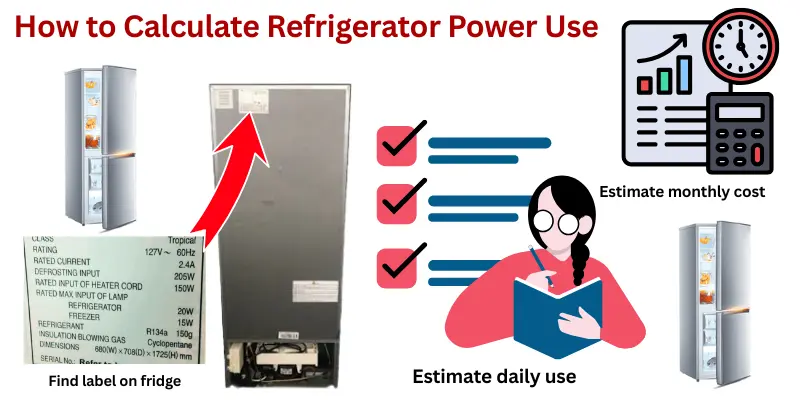
Here are the three easy steps you can follow:
- Find the label on your fridge
- Estimate daily use
- Estimate the monthly cost
Step 1: Find the Label
First, look for the label on your fridge. It is usually found inside the fridge door or on the back side. This label shows important numbers like voltage (V) and current (A).
You can use these two numbers to find the power in watts.
For example, if the label says 2 amps at 120 volts, multiply them:
2 × 120 = 240 watts.
This means your fridge uses 240 watts of power when it runs.
This step helps you know the fridge’s power rating, which you will use in the next steps.
Step 2: Estimate Daily Use
Now that you know the power rating, it’s time to find out how much electricity your fridge uses in one day.
Your fridge doesn’t run all day at full power – it turns on and off. On average, it runs for about 8 hours a day.
You can calculate it like this:
240 watts × 8 hours = 1920 watt-hours, which is the same as 1.92 kWh per day.
This means your fridge uses around 1.92 units of electricity every day.
Of course, small fridges use less and big fridges use more. But this gives you a simple idea.
Step 3: Estimate Monthly Cost
Now, let’s see how much it costs to run your fridge. You can multiply your daily use by the electricity rate in your area.
For example, if electricity costs $0.15 per unit, you can calculate the monthly cost like this:
1.92 kWh per day × 30 days × $0.15 = about $8.64 per month.
This method helps you see how much money your fridge adds to your electricity bill.
You can also use it to compare different fridges and pick the one that saves more energy.
Here’s a simple table that shows the average power use and monthly cost for different types of fridges:
| Fridge Type | Power Rating | Daily Use (kWh) | Monthly Cost ($0.15/kWh) |
| Standard fridge | 240 W | 1.92 | $8.64 |
| Mini fridge | 100 W | 0.8 | $3.60 |
| Full-size fridge | 400 W | 3.2 | $14.40 |
By using this table and these steps, you can easily find out how much electricity your fridge uses and plan to save energy.
Real-Life Examples of Refrigerator Power Use
Knowing the average power use of fridges is helpful, but seeing real-life examples makes it even clearer. Different fridges use different amounts of electricity depending on their size, age, and technology. Here’s a list of common fridges with their power ratings, daily energy use, and estimated monthly cost at $0.15 per kWh:
| Example | Fridge Type | Power Rating | Estimated Daily Use | Monthly Cost ($0.15/kWh) |
| Small fridge | Mini fridge | 150 W | 1.0 kWh/day | $4.5 |
| Medium fridge | Standard fridge | 250 W | 1.8 kWh/day | $8.10 |
| Full-size fridge | Double door | 400 W | 2.5 kWh/day | $11.25 |
| Old fridge | Large old model | 600 W | 3.6 kWh/day | $16.20 |
What these numbers tell us:
- Smaller and newer fridges use less electricity.
- Large or old fridges use more power and cost more each month.
- You can compare your fridge with these examples to see if it’s using more energy than usual.
Tip: If your fridge is older and uses a lot of electricity, consider cleaning it, keeping it in a cool spot, or upgrading to a newer energy-efficient model. These small changes can help save money on your electricity bill.
If you want to know the exact power use of small fridges, you can read how much power does a small refrigerator use.
How to Measure Your Refrigerator’s Power Use
If you want to know how much electricity your fridge uses, it is very easy to check. You can find it at home using a small device called a power meter. This helps you see how much power your fridge really uses every day.
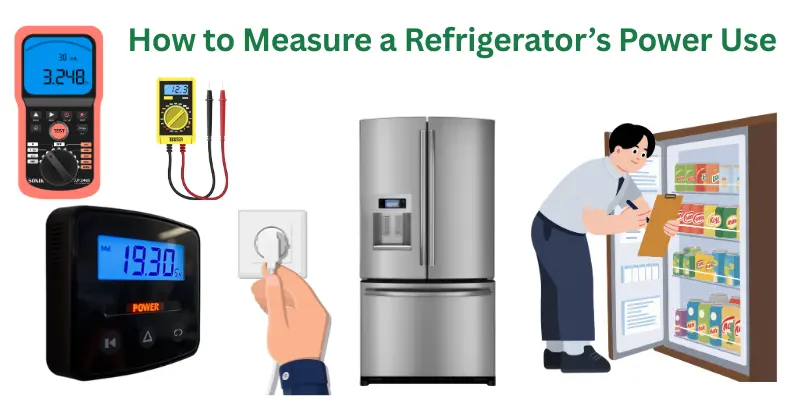
Steps to measure your fridge’s power use:
- Use a plug-in power meter.
- Read the wattage on the meter.
- Check for a few hours to see if the power cycles.
Now let’s talk about each step in detail.
1. Use a Plug-in Power Meter
A plug-in power meter is a small and simple device. You can buy it online or from an electronics shop. To use it, first plug the meter into your wall socket. Then plug your refrigerator into the power meter. Once you do this, the meter will start showing how much power your fridge is using. It works like a small screen that measures the electricity passing through it. This is the easiest way to check your fridge’s power use without any help.
2. Read the Wattage on the Meter
When the fridge is running, look at the meter’s display screen. You will see a number that shows the wattage. Wattage means how much power your fridge is using at that time. The number might change occasionally because the fridge turns on and off to maintain a constant temperature. If the number is high, it means the compressor is working. When the number is low, it means the compressor is resting. Watch it for some time and note the average number you see most often. This will help you know how much power your fridge uses normally.
3. Check for a Few Hours to See the Power Cycle
To get the right result, keep the meter connected for a few hours. This is because a fridge does not run all the time. It works in cycles. Sometimes the compressor turns on to cool, and then it stops for some time. By watching it for a few hours, you will understand how often the fridge runs and how much electricity it uses in a full day. Once you have the reading, you can easily calculate how much electricity your fridge uses daily or monthly.
Tip: You can also use a smart plug that shows electricity use on your phone. It is easy to use and tells you how much power your fridge is using at any time of the day.
How to Reduce Refrigerator Electricity Use
Keeping your fridge energy-efficient is not hard at all. With a few small changes, you can save electricity and lower your bills every month. Let’s look at some easy ways to do that.
Here are some simple tips to save electricity:
- Keep the door closed as much as you can.
- Don’t fill the fridge too much.
- Keep it away from heat and sunlight.
- Clean the coils often.
- Set the right temperature.
- Defrost when you see ice build-up.
- Change to a new energy-saving fridge if yours is old.
Now let’s talk about each one in detail.
1. Keep the Door Closed as Much as You Can
Each time you open the fridge door, warm air goes in and cool air goes out. Then your fridge has to work extra to cool down again, which uses more electricity. Try to open the door only when needed and close it fast. Don’t stand there thinking about what to eat. This small habit really helps save energy.
2. Don’t Fill the Fridge Too Much
When your fridge is packed with food, air can’t move around properly. This makes the fridge work harder and use more power. Try to leave some space between items so air can move freely. A little space can help your fridge stay cool more easily.
3. Keep It Away from Heat and Sunlight
If your fridge is close to a stove, oven, or window with sunlight, it gets warm from the outside. Then it needs to use more power to stay cool. Try placing it in a cool corner of your kitchen where it’s not near any heat. This helps it run better and use less electricity.
4. Clean the Coils Often
Behind or under your fridge, there are metal coils. These help the fridge release heat. When they get dusty, the fridge has to work harder. Clean them every few months using a soft brush or a vacuum. Clean coils help your fridge work better and save power.
5. Set the Right Temperature
The best temperature for your fridge is between 3°C and 5°C. It keeps your food fresh without wasting electricity. If the fridge is colder than needed, it uses extra power for no reason. Just check your settings once in a while to make sure they’re right.
6. Defrost When You See Ice Build-Up
If your fridge is not frost-free, you’ll see ice forming inside after some time. When there’s too much ice, the fridge has to work harder. Defrost it regularly to keep it running smoothly. This helps save electricity and keeps your food fresh.
7. Change to a New Energy-Saving Fridge if Yours Is Old
Old fridges use a lot more power than new ones. Modern fridges with the ENERGY STAR label use much less electricity. They might cost more at first, but they save you money every month. So, if your fridge is more than 10 years old, it’s a good time to upgrade.
Tip: Keep your fridge clean, cool, and not too full. Small steps like these can help you save power, money, and still keep your food fresh.
Yearly Power and Cost Comparison
Different fridges use different amounts of electricity, and that affects your yearly costs. Here’s a quick comparison:
| Fridge Type | Power Use (kWh/year) | Estimated Cost/Year ($0.15/kWh) |
| Mini fridge | 250–400 | $37–$60 |
| Standard fridge | 500–700 | $75–$105 |
| Large fridge | 900–1200 | $135–$180 |
Tip: Inverter models can save 20–30% electricity compared to older fridges. They adjust the compressor speed to use energy more efficiently, which reduces your bills without affecting cooling.
By understanding these numbers, you can choose the right fridge for your needs and save money every year.
FAQ About Refrigerator Power Use
Many people want to know how much electricity their fridge uses and how to save energy. Below are some common questions about fridge power use. We will answer each question in simple words so you can understand it clearly.
- How much electricity does a fridge use per day?
- How much does it cost to run a fridge for 24 hours?
- Does a fridge with a freezer use more electricity?
- Do smart fridges use more electricity than normal fridges?
- How does room temperature affect fridge power use?
- Is it better to keep the fridge full or empty?
- How long does a fridge compressor run each day?
- Can unplugging the fridge on vacation save electricity?
- How does an inverter compressor save electricity?
- What is 1 unit of electricity, and how can I use it to calculate fridge cost?
We will discuss the answer to each question below.
Most fridges use about 1–2 kWh per day. Small fridges use less electricity, and big fridges use more. Old fridges usually use more power than new ones. Energy-efficient fridges use less electricity. Knowing this helps you plan your electricity use and costs.
The cost depends on the fridge’s power and your electricity price. For example, a 200 W fridge running 24 hours uses 4.8 kWh. If electricity costs $0.15 per kWh, it will cost about $0.72 per day. Bigger or older fridges will cost more. Checking the fridge label helps you calculate the cost easily.
Yes, a fridge with a freezer uses more electricity than a fridge without a freezer. The freezer needs to stay very cold, so the compressor works harder. Old fridges use more electricity than new models. If you don’t use the freezer much, keeping it partly empty can save some power. This helps reduce your electricity bill slightly.
Smart fridges have screens, Wi-Fi, and extra features that use some electricity. But modern smart fridges are usually energy-efficient. Most smart fridges use the same or less electricity than older regular fridges. The extra features do not make a big difference in daily power use. So you can enjoy the smart features without worrying much about electricity.
The warmer the room, the harder the fridge works to stay cold. If it is near sunlight, ovens, or heaters, it will use more electricity. Cooler rooms help the fridge use less power. Keeping the fridge in a cool, shaded place saves electricity every day. This is an easy way to reduce power use without changing the fridge.
A fridge works best when it is moderately full. Food helps keep the cold air inside. An empty fridge wastes electricity because the compressor runs more. Do not overfill it because this blocks air circulation and makes the fridge work harder. A balanced fridge saves energy and keeps food fresh.
The compressor does not run all the time. It turns on and off to keep the fridge cool. On average, it runs 8–12 hours per day, depending on size, age, and temperature settings. Older or bigger fridges usually run longer and use more electricity. Understanding this helps you know how much power your fridge really uses.
Yes, unplugging the fridge can save electricity if you are gone for a long time. Empty it and clean it before unplugging. Leave the doors slightly open to avoid mold or smell. Short trips do not save much electricity. This is only useful for longer vacations.
Inverter compressors change speed depending on the cooling needed. They run slower when less cooling is required and faster when more is needed. This saves electricity compared to normal compressors that run at full speed all the time. Most modern inverter fridges use 20–30% less power. They are a good choice if you want to save electricity.
One unit of electricity is 1 kilowatt-hour (kWh). For example, a 200 W fridge running 5 hours uses 1 unit. You can multiply units by your electricity rate to find the cost. This helps you know how much your fridge costs to run. It is an easy way to calculate and plan your electricity bill.
Conclusion
So, guys, in this article, we’ve covered how many watts of power does a refrigerator use in detail. My personal recommendation is to check your fridge’s wattage and make small changes, like keeping it clean, setting the right temperature, and using an energy-efficient model. These steps can save you money and reduce electricity use. Now, why not take a few minutes today to see how much power your fridge really uses?
Want to learn about different fridge styles? Check out our detailed guide on Types of Refrigerators to find which one suits your home best!